

Branching Out

Branching out is the opposite of what Malcolm Gladwell touts in The Outliers, a book that chronicles the careers of some who have dedicated the now well-known goal of ten thousand hours plus to their pursuit of greatness in their chosen field. I have often regretted (self-chastised) not having that sense of focus, persistence, and single-mindedness.
Branching out is resisting our society’s call to narrow. Many stories of those who have reached the pinnacle of greatness include their philosophy that failure was not an option; they would not stop until they reached their goal. No matter what. Narrowing to the extreme.
“To reach peak efficiency, a capitalist society must therefore apply a quiet but mounting pressure to forsake relationships for riches,” states Robert Moor in his book In Trees.
But there are examples of people branching out, finding success on multiple limbs. Renaissance women and men. Before Steve Martin was one of our beloved actors, he was an outlier in the field of stand-up comedy. Perhaps he shocked his fans and the industry when he quit the circuit at the height of his popularity - to become an actor. Many were surprised by his success there, having pegged him in a confining and restricting hole that only fit a stand-up comic. Martin has other healthy branches. He is also a darn good banjo player and has written novels and plays, falling one letter short of an EGOT, missing a Tony. I don’t know about the status of his relationships, but I hold him in high esteem as a beautiful branchy tree, sharing his talent with the world.
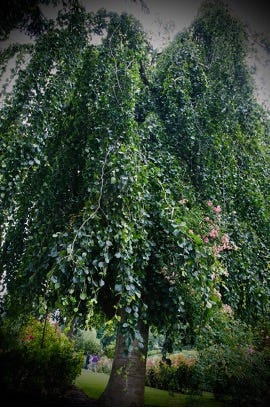
There is a window by my desk that looks out to the treetops of two maturing trees that flank our walkway. I am happy for their branch-i-ness providing shade and beauty. They add wellness to the greenspace surrounding our house.
On the opposite end of the tree spectrum are Bonsais. Robert Moor spends a chapter of his book sharing the magic and wonder of the art of trimming and refining Bonsai trees. He questions if they are, in fact, trees since by definition a tree can grow tall. Bonsai trees are carefully and lovingly manipulated into items of beauty, some of which value in the millions and are centuries old. Masahiko Kimura is a widely recognized master. You can view some of his creations here.
I mistakenly believed the roots of trees generally equal the width of the branches. Moor tells me they may extend two or three times beyond the crown. Bonsai trees are not planted in the ground. The roots are often exposed, part of the art. One of the tricks of a Bonsai master is to restrict the roots. Narrowing. Manipulating nature to reach a human ideal.
It is not a big leap to consider the popularity of altering one’s appearance for the sake of “fitting in,” or achieving a human idea of beauty. I’d extend the metaphor, wondering if that equals denying one’s “roots,” the natural beauty into which one was born. I am saddened by the trend to appear “perfect” in our plasticized, cgi- or ai-animated world. Give me a movie populated with real world, non-beautiful actors any day. Those who resist the industry pressure to conform to some narrow ideal are my Hollywood legends for they have resisted the pressure to narrow.
Maybe it is laziness or lack of focus that has made my personal tree of life one with many branches, reaching outward and upward willy-nilly. Even downward. It can leave one feeling unsuccessful by confining standards, but Moor has helped me realize there is value in branching out.
***
For those of you following the menacing misfortunes of Mandy Watkins, protagonist of my first novel THE ART COLONY, in Friday’s post (chapters 34 -36) Grant is forced to intervene in an epic fight between Selena and Mandy.
Subscribers receive notices of new chapters dropped and can access them on the Substack app.
Thanks for reading.